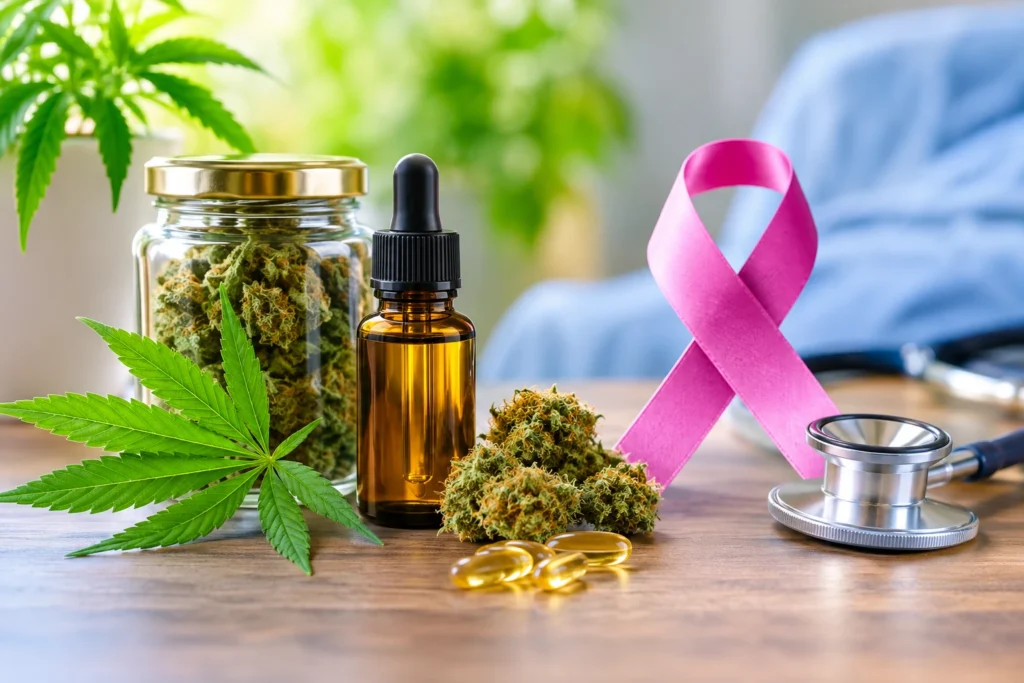
Pain associated with the cancer may become almost omnipresent in one’s life. Such conditions as surgery, chemotherapy, radiation therapy, inflammation, and tumor development itself may cause pain. Even though opioids still play a vital role in pain management among cancer patients, the issues of side effects, tolerance, and dependence have made many researchers look into additional ways to alleviate pain.
Medical Cannabis became a subject of interest among the scientific community due to its ability to help with pain and other symptoms of the disease. The researchers are investigating whether Medical cannabis-derived substances, such as THC and CBD, might be used to help patients along with currently known pain-relieving measures.
Nevertheless, the scientific facts are more complex than they appeared to be at first glance. On the one hand, there are several studies that indicate improvement of pain and less usage of medication, but on the other hand, controlled clinical trials were not able to show opioid sparing effect of the substance.
Looking for reliable medical cannabis information?
Explore your options and learn how a qualified healthcare professional can help you understand safe, personalized approaches to symptom management.
>>Learn More<<
Cancer Pain and the Limitations of Conventional Medicine
There is no one particular reason for cancer pain. It is caused by tumors pressing on nerves, destroying tissue, or spreading in bones or other organs. Cancer pain can also be caused by medical procedures and cancer therapies.
Cancer pain is usually categorized by healthcare professionals as follows:
- Nociceptive pain – Pain caused by damage or inflammation activating the pain receptors.
- Neuropathic pain – Caused by the destruction of nerves through cancer or cancer treatments.
- Pain from treatment – Surgery, chemotherapy, radiation or other medical procedures may cause pain.
- Breakthrough pain – Pain episodes where the patient experiences sudden increase of pain in spite of current therapy.
Morphine and oxycodone are opioids and they are typically used for treatment of moderate to severe cancer pain. Opioids can effectively reduce cancer pain but they also cause constipation, nausea, drowsiness, breathing difficulties, and physical dependence.
Such limitations have led to research of alternative methods for pain relief including Medical Cannabis even though cannabis cannot be regarded as an approved alternative for cancer pain medications.
The Effect of Medical Cannabis Chemicals on Perceptions of Pain
The plant Medical cannabis is made up of many naturally occurring chemicals known as cannabinoids. Two of the most studied are THC and CBD.
Both of these chemicals affect the signaling systems of the body which control functions such as pain sensations and inflammation.
THC and Its Potential for Relieving Pain
THC affects the cannabinoid receptors, which include CB1 and CB2, which affect multiple bodily processes.
Scientists have conducted research into THC because of its potential to affect perceptions of pain, muscle tension, and nausea. However, THC may also have adverse effects, such as dizziness, poor coordination, and anxiety.
CBD and its Possible Therapeutic Features
In contrast to THC, CBD lacks the ability to trigger such effects. Scientists are studying the possible interaction of CBD with inflammatory pathways and other receptors responsible for pain transmission.
However, research showing that CBD could be a good treatment option for cancer-related pain is scarce. It is necessary to be careful not to mistake the possible effects with the clinical results.
Also, scientists are considering the combination of both cannabinoids. Some researchers have decided to find out whether the right combination of THC and CBD could provide distinct symptom management results.
Research on Medical Cannabis and Cancer Pain
There is an important study done as an observational research in the BMJ Supportive & Palliative Care. This study involves 358 cancer patients who were treated with Medical cannabis in Quebec, Canada.
Patients were followed for about 3.5 years. Among other reasons for using Medical cannabis, the major one was pain. Throughout the follow-up period, there were reports of positive changes in such pain characteristics as mean pain intensity, worst pain and interference of pain with usual activities of daily living.
Also, there were reports of reduction in medications usage, including opioids in some follow-ups.
These findings became popular since they showed that cannabis-based products can be a part of supportive care in case of cancer. The observational nature of research does not allow claiming any causal relationship; other types of therapies, changes in health condition, individual differences etc. might influence the findings.
The research thus provides valuable evidence for further studies, not the evidence of the direct effect of Medical Cannabis on opioid requirements reduction.
Current Studies Challenge the Opioid Reduction Theory
Current literature has brought into light the limitations in pain treatment using cannabis-based products.
An evidence summary of 2024 published in the American Family Physician, based on Cochrane review, analyzed the cannabis and synthetic cannabinoid products for pain related to cancer. There were some improvements observed in some patient-reported measures as compared to placebo; however, no reduction in opioid usage or total pain scores was observed. Also, some products were associated with increased central nervous system adverse effects.
A crucial finding in this regard is a systematic review and meta-analysis of 2026 published in Supportive Care in Cancer. The study involved analysis of 15 articles, including 10 articles in meta-analysis, and evaluated whether cannabinoids lower opioid usage among individuals suffering from cancer pain.
There were no conclusive results of reduced opioid usage when compared with placebo-controlled studies. However, although there were a few results of reduced maintenance opioid doses in individual studies, there were inconsistencies and heterogeneity of evidence and low certainty of evidence.
Thus, the current study proves that the Medical Cannabis should not be considered at present as a reliable solution for prevention of opioid addiction and substitution therapy for opioids.
What Guidelines Has the American Society of Clinical Oncology Released?
The American Society of Clinical Oncology (ASCO) released guidelines on the use of Medical cannabis and cannabinoid preparations in adult patients with cancer in 2024.
The guideline assessed existing systematic reviews, randomized controlled trials, and observational studies to assess both benefits and possible risks from their use.
The guideline notes that there is insufficient scientific evidence on the effectiveness of many cancer-related uses. Specifically, it is not recommended to use cannabis and cannabinoids as cancer therapies except for clinical trials.
The guideline mentions that some forms of cannabinoids may have a potential effect on refractory chemotherapy-induced nausea and vomiting as adjuncts to current antiemetic therapy. The evidence for other supportive care uses is still lacking.
It is necessary to note that cannabis may be studied as a symptomatic therapy but not as a cancer treatment.
Risks and Safety Issues Involved
Despite the claims made by some people about their good experiences, it is not entirely safe to take Medical Cannabis. Some issues determine its safety, such as concentration of the cannabinoids, formulations, dosage, use frequencies, and individual health problems.
Some possible negative impacts include:
- Dizziness and lack of coordination.
- Sleepiness and lack of ability to concentrate.
- Anxiety, confusion, or alteration of perception.
- Heartbeat rates increases for some people.
- Possible interactions with other drugs.
- Possible liver complications with certain CBD formulations.
People with cancer must be extremely cautious while using this medicine because the cannabinoids can interact with the medications that are processed through the liver or alter the impact of other prescribed medicines.
Combining this plant with opioids or sedative medicines can exacerbate safety problems as well.
Any person who plans to use Medical Cannabis must first consult an oncologist or another specialist. No one is allowed to decrease or stop taking opioids on his own.
Why Further Clinical Research Is Needed
Although interest in the matter is rising, there are some key issues that still need to be clarified.
Future clinical trials require exploration of cannabinoid preparations that can lead to some relief, required doses, duration of treatment, and patient eligibility.
Scientists should also learn to differentiate between improvements in pain severity, sleep quality, anxiety level, and reduction in opioid use. All these factors are distinct and cannot be considered substitutes for each other.
Further randomized trials may help determine if Medical Cannabis can provide any extra advantages in combination with usual cancer pain management approaches.
Furthermore, more research is necessary in terms of safety, possible drug interaction, and differences between THC dominant, CBD dominant, and balanced cannabinoid medications.
Frequently Asked Questions (FAQs)
1. Is Medicinal Cannabis capable of providing relief from cancer pain?
Some studies indicate that it may be able to provide relief and increase comfort of certain cancer patients. Nevertheless, the clinical evidence is inconclusive, and it cannot replace regular pain medication.
2. Does cannabis lower the amount of opioids consumed by cancer patients?
It was found that some cancer patients who use cannabis may reduce their opioid intake. However, this effect is not conclusively supported by clinical trials.
3. Which cannabis constituents are examined in relation to cancer pain?
Two compounds which are studied the most are THC (tetrahydrocannabinol) and CBD (cannabidiol). It is examined how cannabinoids affect biological mechanisms involved in pain and inflammation.
4. Is CBD effective in treating cancer pain?
The potential therapeutic uses of CBD are under investigation. At this time, there is not enough evidence to conclude about its efficiency in treating cancer pain.
5. Are cancer patients allowed to use cannabis along with opioid drugs?
Some cancer patients use cannabinoid preparations along with prescribed pain medication. It is not advisable to do so because it can increase adverse effects.
Conclusion
The connection between Medical cannabis, cancer-associated pain, and opioid medications is a significant subject matter in current medical research. Some positive changes observed in patient experience were noted by some observational studies, but recent controlled data do not support the efficacy of cannabinoids in reduction of opioid use.
It can be hypothesized that Medical Cannabis might serve as an auxiliary tool in supportive care of specific patients with cancer, but there are many other things to consider regarding the efficacy and safety of this treatment modality.
Patients with cancer should focus on safe pain management developed in collaboration with a professional healthcare provider, and cannabis-containing products should be evaluated after consulting the medical team.
Sources and References
1. Aprikian et al. (2024) – Medical Cannabis Is Effective for Cancer-Related Pain: Quebec Cannabis Registry Results.
BMJ Supportive & Palliative Care.
Read Research Study.
2. Braun et al. (2024) – Cannabis and Cannabinoids in Adults With Cancer: ASCO Guideline.
Journal of Clinical Oncology.
Read Full Research and Guidelines.
3. Sonoda (2024) – Cannabis Use for Cancer-Related Pain.
American Family Physician.
Read Clinical Evidence Review.
4. Cochrane Review (2023) – Cannabis-Based Medicines for Adults With Cancer Pain.
Cochrane Database of Systematic Reviews.
Read Cochrane Review.
5. BMJ Group – Medicinal Cannabis and Cancer Pain Management.
Research summary covering 358 cancer patients in the Quebec Cannabis Registry.
Read BMJ Research Summary.